
Natural Stone vs. Concrete Pavers: Which Fits Your Patio Project?
Choose natural stone when authentic variation, individual surface character, and a layout shaped around the material are priorities. Choose concrete pavers when a defined manufactured system, repeated modules, and product-line documentation better suit the design. Neither material is automatically more durable, safer, easier to maintain, or less expensive. Those outcomes depend on the exact product, finish, installation assembly, exposure, workmanship, and maintenance program.
A balanced decision matrix
| Decision | Natural stone may fit better when | Concrete pavers may fit better when | Verify for either |
|---|---|---|---|
| Appearance | Piece-to-piece color, grain, cleft, and edge variation are part of the design | A repeated shape system and a selected manufactured appearance are preferred | Representative samples, acceptable range, finish, and viewing conditions |
| Layout | The plan can respond to irregular or dimensional natural pieces | The geometry coordinates efficiently with the selected modular sizes | Pattern overlay, borders, curves, penetrations, narrow cuts, and joint width |
| Documentation | The exact stone has suitable current test data and supplier documentation for the use | The exact paver system has suitable current technical data and installation instructions | Do not transfer claims from a different stone, finish, paver line, or assembly |
| Repairs | Natural variation and a saved reserve can make selective blending acceptable | Replacement units from a compatible run can be sourced and the modular pattern can be reopened | Later availability, production or lot differences, access, and repair method |
| Maintenance | The owner accepts care based on the selected stone, finish, joints, and exposure | The owner accepts care based on the selected manufactured unit, surface, joints, and system | Written cleaning, joint, stain, sealer, deicing, and repair guidance for exact products |
| Budget | The complete installed natural-stone design fits the budget | The complete installed paver system fits the budget | Comparable scope, including base, labor, cuts, edges, waste, accessories, and maintenance |
Case 1: The client wants visible natural character
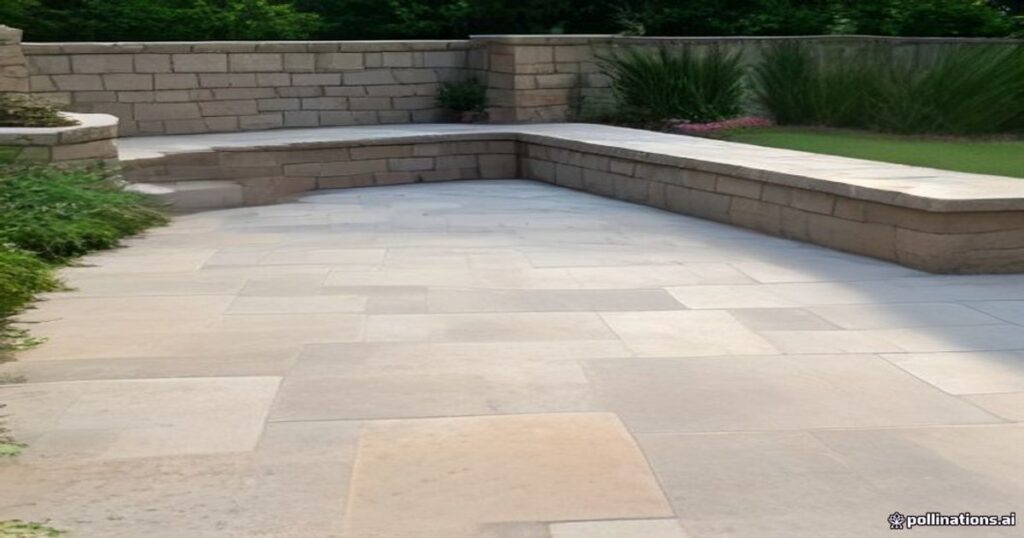
Natural stone has the clearer design case when the brief welcomes tonal movement, mineral markings, texture, and pieces that are not visual copies of one another. Approval should cover a representative range, not one ideal sample. The layout and blending plan need room to distribute variation across the patio rather than isolating all similar pieces in one area.
This preference does not excuse missing technical evidence. Ask for current information tied to the exact stone and finish. A broad rock name is not enough to establish wet traction, freeze-thaw behavior, dimensional properties, or suitability for a specific assembly. Where performance matters, the designer should evaluate applicable ASTM test results, Natural Stone Institute guidance, and project conditions.
Case 2: The plan depends on repeated modules
Concrete pavers may be the more direct fit when the selected product line provides modules that coordinate cleanly with a rectangular field, border, or repeated pattern. Manufactured does not mean every unit or production run is visually identical. Review current samples and documentation, and ask how production-run variation and later matching should be handled.
The paver manufacturer should provide current installation and maintenance instructions for its system. ASTM product standards can define test methods or classifications, but compliance and values must be confirmed for the exact product. Do not treat a generic statement about concrete pavers as evidence for every line, surface treatment, or application.
Case 3: The patio has curves, interruptions, and tight transitions
Neither material wins by category. Put both patterns on the same drawing. Count narrow slivers, repeated cuts, border interruptions, and awkward meetings at steps, drains, posts, and doors. An irregular stone layout may absorb some geometry visually but require more fitting. A modular paver pattern may install efficiently in an open field but create repeated edge cuts around a complex perimeter. The actual layout reveals the tradeoff.
The walkway and patio planning material can provide natural-stone context. For a concrete option, use the candidate manufacturer’s current technical data rather than a competing retailer’s summary. Ask the installer to price each complete cut plan, not only the net square feet.
Compare assemblies, not loose surface units
A fair comparison includes excavation, subgrade preparation, base, bedding or setting materials, edge restraint, joints, drainage, movement details, transitions, and labor. The qualified designer and installer should establish each assembly for the site, climate, loading, and code conditions. A stone over one assembly and a paver over another are not equivalent merely because both cover the same area.
Finished elevation can eliminate an otherwise attractive option. Check available depth at thresholds and adjoining paving. Confirm whether unit thickness or thickness variation can be accommodated by the chosen setting method. Follow manufacturers’ instructions for every proprietary component. Do not assume that a method shown for one product transfers to another.
Repairability is a planning question, not a promise
For natural stone, document material identity, save representative photos, and consider retaining labeled reserve pieces. A future exact match cannot be promised because lots and natural character vary. For concrete pavers, retain the manufacturer, line, color, size, finish, production information if available, and reserve units. A future run may differ or the line may change. In both cases, repair feasibility also depends on whether the assembly can be opened without damaging adjacent work.
A five-question decision test
- Does the design welcome natural variation or depend on repeated manufactured modules?
- Which exact candidate has documentation appropriate to the exposure and intended use?
- Which pattern resolves the actual geometry with acceptable cuts and joints?
- What is the comparable installed scope, not just the surface-material price?
- Which maintenance and future-repair uncertainties is the owner prepared to accept?
If one option wins only because its quote omits part of the assembly, the comparison is unfinished. If one wins after the same drawing, performance questions, installation scope, maintenance horizon, and repair assumptions are applied to both, the decision is defensible.