
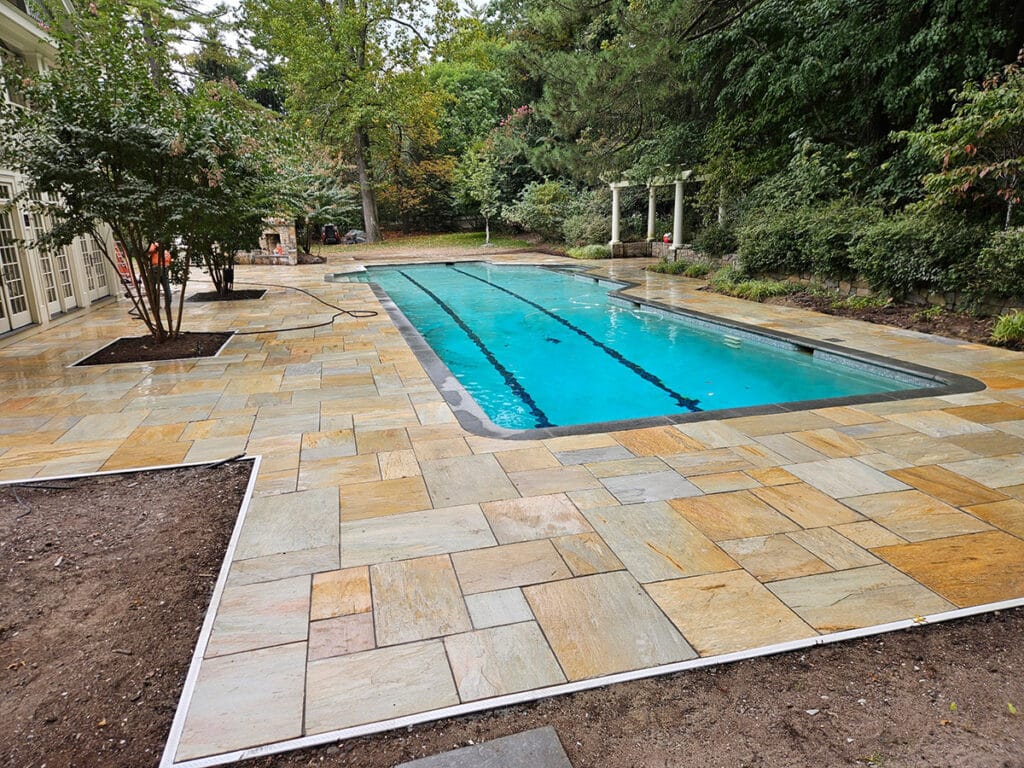
Choosing Natural Stone for a Saltwater Pool: What to Verify Before Ordering
For a saltwater pool, evaluate the exact stone and finish as one component in a repeatedly wet, chemically managed assembly. The decision should address the documented stone properties, salt and moisture exposure pathways, wetting and drying, freeze-thaw conditions where applicable, setting and joint materials, metals, drainage, cleaning, and maintenance. No broad stone type is automatically “salt-proof,” and the phrase saltwater pool does not define the operating chemistry.
Follow the documented exposure
Begin at the water and map direct splash, persistently damp locations, drainage paths, joints, setting materials, and nearby metal components. Also record irrigation, deicing materials, cleaners, roof runoff, and soil contact because they are separate exposures. This map is project evidence, not proof that the stone will pass or fail.
Do not infer a damage mechanism from a white deposit or a stone name. The Natural Stone Institute's current laboratory scope identifies EN 12370 as a salt crystallization resistance method. A result from that method can describe how identified submitted specimens responded to its laboratory cycles. It cannot duplicate a particular pool's chemistry, splash rate, drying pattern, climate, cleaner, sealer, setting bed, joints, drainage, or metals, and it does not apply to the proposed finish unless representative finished specimens were actually tested.
The evidence hierarchy
- Project operating information. The pool professional documents the treatment system, target operating conditions, startup, monitoring, seasonal procedures, and products expected to contact the stone.
- Exact stone identity. The supplier provides the current material description, finish, format, and available technical documentation for the candidate.
- Applicable stone data. The designer reviews relevant physical-property and durability information, test methods, specimen identity, and limitations. Data for another stone or finish should not be transferred casually.
- Assembly-component instructions. Manufacturers of mortars, membranes, grouts, joint products, sealers, cleaners, and metal components confirm their own compatibility and use requirements.
- Project-specific professional judgment. The pool builder, installer, designer, or other qualified professional reconciles the evidence with exposure, climate, geometry, drainage, movement, and maintenance.
- Representative mockup or test area. When appropriate, a controlled sample assembly checks appearance and maintenance assumptions without pretending to predict every long-term condition.
Claim-linked test-method questions
The specific methods below appear in the Natural Stone Institute's current natural-stone laboratory scope. The source identifies an ISO/IEC 17025 accredited stone laboratory and maps each property to a named method. It does not publish a result for the stone being considered here. Ask for the complete report, current standard revision, specimen description, finish, conditioning, values, and laboratory identification.
| Source and method | What a matching report can establish | What it cannot establish |
|---|---|---|
| ASTM C97, absorption, density, and bulk specific gravity | The reported absorption and density-related values for the identified specimens under that method | Salt crystallization resistance, wet traction, installed drainage, or performance of another quarry source, lot, or finish |
| ASTM C1353, abrasion resistance | The abrasion result for the identified specimens under the specified laboratory procedure | Wet slip resistance, salt compatibility, barefoot comfort, or durability of the complete coping and deck assembly |
| ASTM C1721, petrography | The petrographer's observations and characterization of the submitted stone specimens | A universal service-life prediction or proof that visually similar supplied pieces share every observed characteristic |
| EN 12370, salt crystallization resistance | The response of identified specimens to that method's salt-crystallization protocol | Compatibility with the exact pool chemistry, finish, wetting and drying pattern, cleaner, sealer, mortar, joints, metals, drainage, or maintenance plan |
| ASTM C666, ASTM C1645, or EN 12371, listed freeze-thaw exposure methods | Only the protocol-specific result for identified specimens tested by the selected applicable method | Interchangeability of the three methods, a blanket freeze-thaw approval, or installed performance in an untested saturated assembly |
The Natural Stone Institute's 2024 Dimension Stone Design Manual library is a current industry design reference with stone-specific chapters, test-method discussions, horizontal-surface guidance, and wet-area material. It can frame the qualified review, but it is not a certificate for a particular Wicki Stone selection, lot, finish, fabricated piece, or pool assembly.
The assembly compatibility conference
Place the stone, setting bed, substrate, waterproofing or drainage layers, joints, movement details, adjacent metals, and maintenance products on one review sheet. Ask each product manufacturer about its own component under the documented exposure. Conflicting instructions are a stop condition until the project professional resolves them.
Pay special attention to coping edges, joints, penetrations, cover tracks, anchors, rails, skimmers, and meetings with the deck. These locations combine geometry, water movement, and multiple materials. The natural stone coping overview can support the shape discussion, but exact profiles, fabrication scope, and availability require order-specific confirmation.
Maintenance is part of selection
Request written cleaning guidance for the exact stone and all selected products. Identify who will monitor pool chemistry, rinse or clean splash zones if required by the approved plan, address deposits, and respond to staining or joint deterioration. Avoid improvised acids, harsh tools, or unverified chemical combinations. Safety data sheets and manufacturer instructions control handling.
If a sealer or treatment is proposed, require documentation for the exact product, stone, finish, wet area, and maintenance regime. Test appearance on representative material when advised. Do not assume treatment creates immunity from salt, water, stains, slipping, freezing, or maintenance.
A saltwater-specific release gate
Record negative findings as carefully as positive ones. If documentation does not address the proposed finish, if a component manufacturer will not confirm the intended exposure, or if maintenance responsibilities are undefined, mark the issue unresolved. Silence is not compatibility evidence. An alternate material or assembly should pass through the same review rather than being accepted merely because its trade name sounds more suitable.
Keep the evidence set tied to revision dates. Changes to water treatment, coping profile, setting product, joint material, drainage detail, cleaner, or sealer can reopen the compatibility decision even when the stone selection stays the same.
- Pool treatment and maintenance plan documented by the responsible professional
- Direct splash, evaporation, drainage, and secondary chemical exposures mapped
- Exact stone, finish, format, and technical evidence identified
- Climate and wetting-drying conditions reviewed
- Setting, joint, membrane, metal, cleaner, and treatment compatibility checked
- Coping and deck transitions detailed
- Current manufacturer instructions reconciled
- Owner maintenance responsibilities accepted
- Unresolved evidence gaps assigned before purchase
This gate differs from a general pool comfort comparison. It asks whether the documented stone and every adjoining component can be responsibly specified for the operating and exposure plan. If the answer depends on a generic claim about saltwater, the evaluation is not complete.