
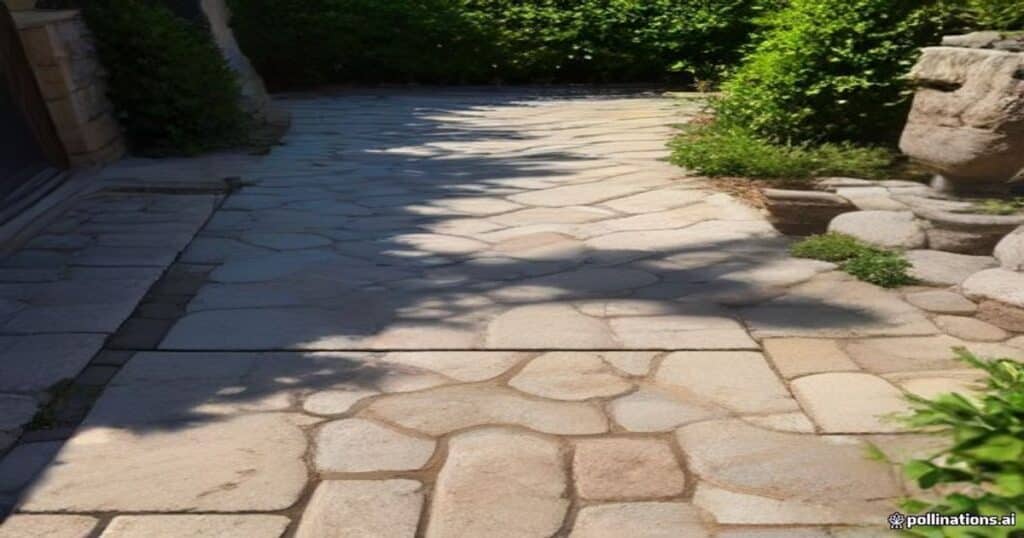
What Should Go Between Flagstones? Choosing Joints for Your Installation
What goes between flagstones depends first on whether the approved installation is flexible or rigid. Then joint width and depth, drainage, movement, traffic, slope, maintenance, and the exact joint product’s instructions narrow the choice. Loose aggregate, planted joints, manufactured jointing material, and mortar are different systems, not interchangeable colors.
Use this conditional selection tree
- Is the flagstone mortar-set on a professionally approved rigid assembly? If yes, evaluate a compatible mortar-based joint detail specified for that assembly. Do not substitute a flexible-joint product because it looks similar.
- Is it a flexible assembly over a prepared aggregate base? If yes, continue with loose aggregate, planting, or a manufactured product specifically documented for the measured conditions.
- Are the joints within the selected product’s stated width and depth limits? If no, eliminate that product or redesign the joint with the responsible installer.
- Will water drain as the assembly requires? If no, correct the drainage design before choosing a joint filler.
- Is the route mobility-critical, regulated, sloped, or exposed to concentrated traffic? If yes, obtain qualified design review rather than relying on a decorative comparison.
- Can the owner perform the required maintenance? If no, eliminate options whose refill, weeding, cleaning, curing, or repair demands will not be met.
Option file: loose aggregate
Loose aggregate can fit some flexible installations where the base, edge restraint, joint geometry, drainage, and maintenance plan are designed for it. Particle size and shape affect how material settles, migrates, and feels underfoot, but a generic stone name does not establish performance. The installer should review a representative sample and the actual joint range.
Expect maintenance questions rather than a maintenance-free promise. Material may need redistribution or replenishment, and runoff, cleaning, foot traffic, pets, or equipment can move particles. Edges and adjoining surfaces matter. Do not assume loose aggregate is suitable for an accessible route or a steep condition. Applicable accessibility and site standards require a stable, firm, and slip-resistant route as defined by the authority having jurisdiction and the project professional.
Option file: planted joints
Planted joints make the joint a growing zone. That requires enough suitable space for the selected plant, compatible moisture and sun conditions, a maintenance plan, and a flagstone layout that tolerates the intended appearance. A plant professional should select species for the site. The installation still needs an approved base, drainage, edge condition, and walking surface.
Consider how irrigation, soil migration, seasonal dormancy, weeds, and foot traffic affect the result. Planting between stones does not automatically create a permeable, low-maintenance, or accessible surface. Those outcomes depend on the complete design and ongoing care.
Option file: manufactured jointing products
This category includes products with materially different binders, installation steps, joint limits, drainage requirements, cure conditions, and maintenance instructions. Product selection must be based on the exact current technical data sheet, installation instructions, and safety information. The product manufacturer is the authority for its own stated uses and limitations.
ANSI standards and ASTM test methods may be referenced by a manufacturer, but a standards number alone does not prove that a product suits a specific flagstone assembly. Confirm that the documentation addresses natural stone, the installation type, measured joint width and depth, base drainage, expected traffic, slope, cleaning, weather during installation, and cure protection. Do not combine instructions from different brands or old data sheets.
Option file: mortar-based joints
Mortar joints belong to a designed rigid assembly. The substrate, setting bed, bond, movement provisions, drainage, joint geometry, stone properties, and exposure must work together. Cracking or debonding cannot be prevented by selecting a mortar color at the end. The qualified designer or installer should specify the assembly, and each product manufacturer should confirm its own component requirements.
If the patio is over a structural slab, waterproofed area, or occupied space, professional detailing is essential. Movement locations and transitions cannot be guessed from the flagstone pattern. A stone supplier can provide current stone information, but is not the default designer of the supporting system.
Measure before naming a product
Create a simple joint survey from the approved layout or mockup. Record the narrowest, typical, and widest joints, plus available depth after setting. Include tapered gaps around irregular pieces. Mark stairs, drains, curves, edges, and locations exposed to concentrated runoff. Photographs should include a scale reference.
The walkway stone information can help frame the flagstone format discussion. It does not replace the joint manufacturer’s current instructions. Before installation, compare every measured condition with the selected product’s requirements and resolve any outliers in writing.
Maintenance decides close calls
| If the owner prioritizes | Ask before selecting |
|---|---|
| A loose, informal appearance | How will migration, replenishment, edging, and cleaning be managed? |
| Living joints | Who will manage irrigation, weeds, traffic damage, and seasonal change? |
| A bound joint in a flexible assembly | Does the exact product document compatibility with every measured condition? |
| A rigid finished joint | Has the complete mortar-set assembly and movement strategy been professionally approved? |
The final choice should be expressible as a chain of evidence: approved assembly, measured joints, documented drainage and traffic, exact current product instructions, and an owner who accepts the maintenance. If the chain breaks, the joint material is not ready to select.